The Geinsheim Vanguard: The Revolutionary Flight of the Mohrs
This ledger merges explicitly linked dossiers with people inferred from archive photo tags and chapter prose, then renders only verified claim groups.
Johann Adam Mohr
profileJohann Adam Mohr was born 1811.
- Spouse links: Anna M. Eckert.
- Child links: Henry Mohr.
Henry Mohr
profileHenry Mohr was born November 15, 1850 in Walworth County, Wisconsin and died February 16, 1911.
- Documented residence or settlement: Walworth County, Wisconsin.
- Recorded role or occupation: Farmer and stock dealer.
- Spouse links: Martha Katzman, Mary Smith.
Joyce Streich
profile- Spouse links: Melvin Streich.
- Parent links: Willard T. Morrow, Clara Murdock, Pearl Holzworth Morrow.
- Child links: Debra Streich, Patricia Streich, Jeff Streich, and 6 more.
Melvin Streich
profile- Spouse links: Joyce Streich.
- Child links: Jeff Streich, Debra Streich, Patricia Streich, and 6 more.
Preamble: A Legacy of Dissent
### 🛡️ The Mohr-Streich Nexus Before diving into the revolutionary fires of 1848, it is essential to understand how the Mohr name became a pillar of the Streich family story. The connection was forged in the 'German Settlement' of Spring Prairie, Wisconsin, where two foundational lines merged. **The Union**: Henry Mohr, the son of our Geinsheim revolutionaries, married **Martha Katzman** in 1874. Their lineage eventually joined the Streich clan through the marriage of **Melvin Streich and Joyce Morrow**, uniting the Irish-pioneer heritage of the Morrows with the deep-rooted German resilience of the Mohrs and Streichs. ### 🚩 Why This Story Matters The Mohr Migration is not a typical 'immigrant seeking land' story. It is a **Political Flight**. Johann Adam Mohr and Anna M. Eckert didn't just move; they escaped. By tracing their journey from the epicenter of the 1848 German Revolutions to the Wisconsin prairie, we uncover a legacy of dissent, democratic resolve, and the courage to build a new society from scratch. For every Streich and Mohr descendant today, this Chronicle serves as a reminder that our roots are planted in the soil of revolutionary freedom.
The Fires of the Pfalz (1848)
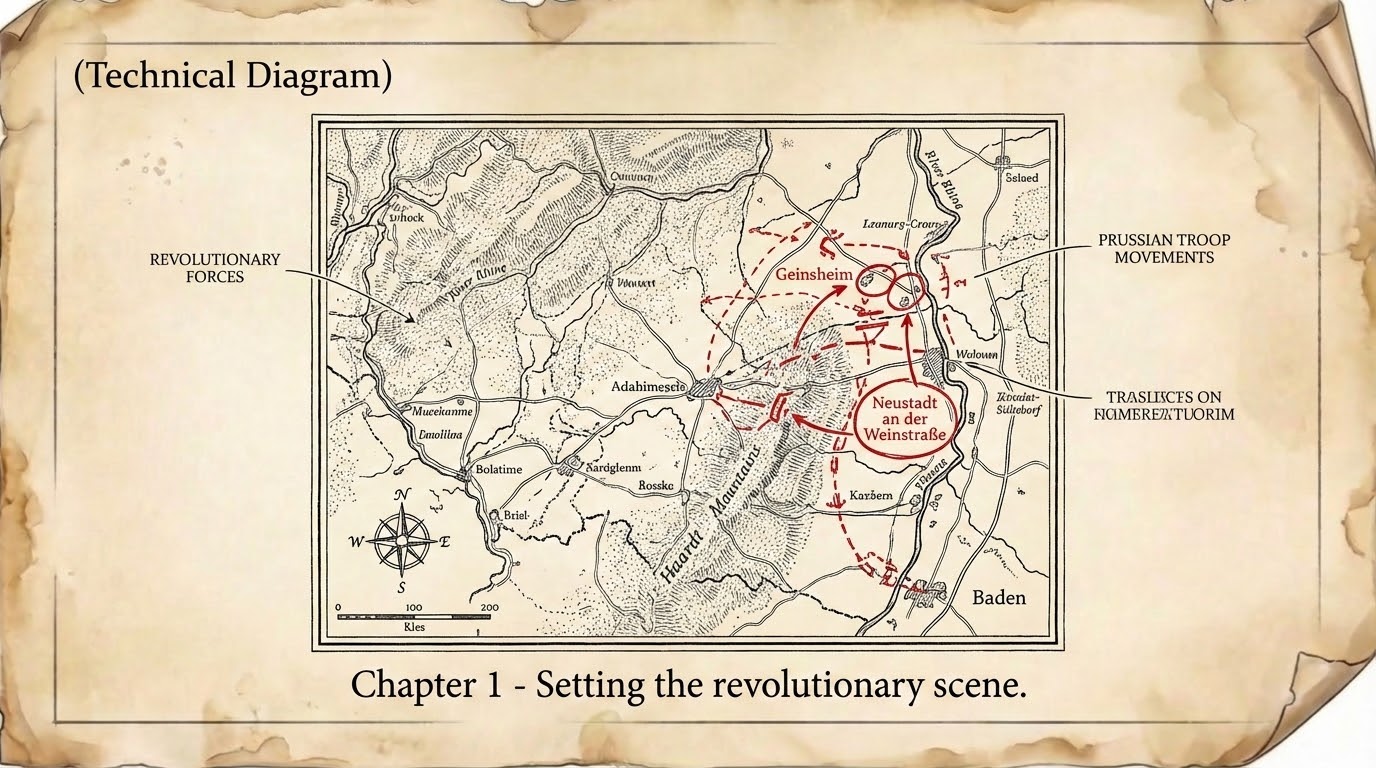
In 1848, the village of Geinsheim sat in the crosshairs of history. Nestled in the heart of the Palatinate (Pfalz), it was just a few miles from Neustadt an der Weinstraße, the epicenter of the first great German democratic movement. Johann Adam Mohr was thirty-seven years old—a man in his prime during the March Revolution. This wasn't just a period of unrest; it was a total rejection of monarchy. The air in the Rhine valley was thick with the rhetoric of the Hambach Festival, where thousands demanded a unified, democratic Germany.
Technical Div.
Tactical layout of the Pfalz uprisings, 1848. Highlighted coordinates for Geinsheim and Neustadt.
The Revolutionary Epicenter
When the revolution was brutally suppressed by the Prussian and Bavarian armies in 1849, men like Johann Adam faced a stark choice: submission or flight.
The Port of Havre Escape
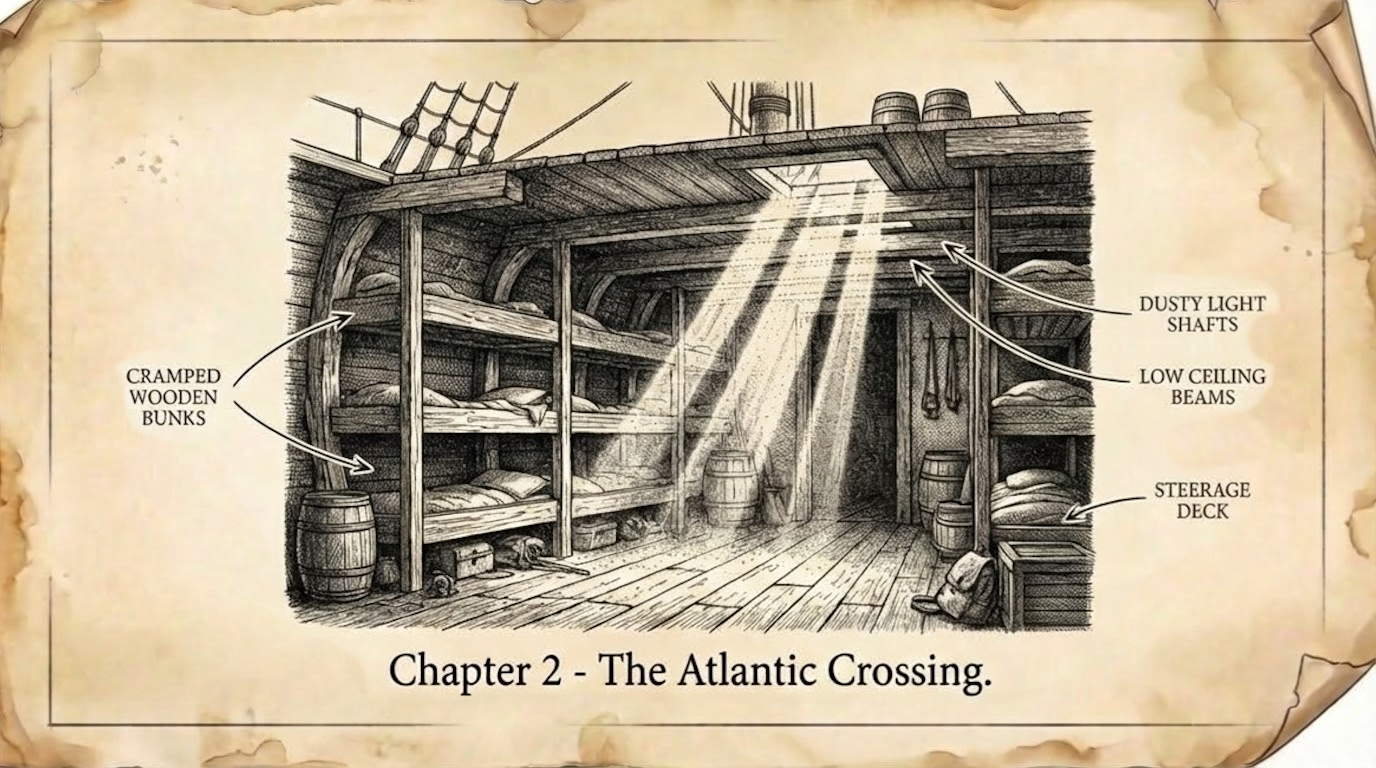
The escape was not a simple departure. To avoid the prying eyes of Prussian spies and the heavy duties of northern German ports, many Palatine revolutionaries chose the France route. Johann Adam and Anna M. Eckert likely traveled overland across the French border to the port of Le Havre.
Technical Div.
A technical reconstruction of conditions aboard the mid-19th century transatlantic crossing from Havre to New York.
The Steerage Gamble
There, they joined the steerage class—the hundreds of souls packed into the unventilated bellies of sailing ships for five to ten weeks. The voyage across the Atlantic in 1848 was a gamble with disease and storms, but for the Mohrs, the promise of the American interior was worth the risk. They arrived at the eastern ports and immediately turned their eyes toward the Great Lakes.
The Rhenish Cluster at Spring Prairie
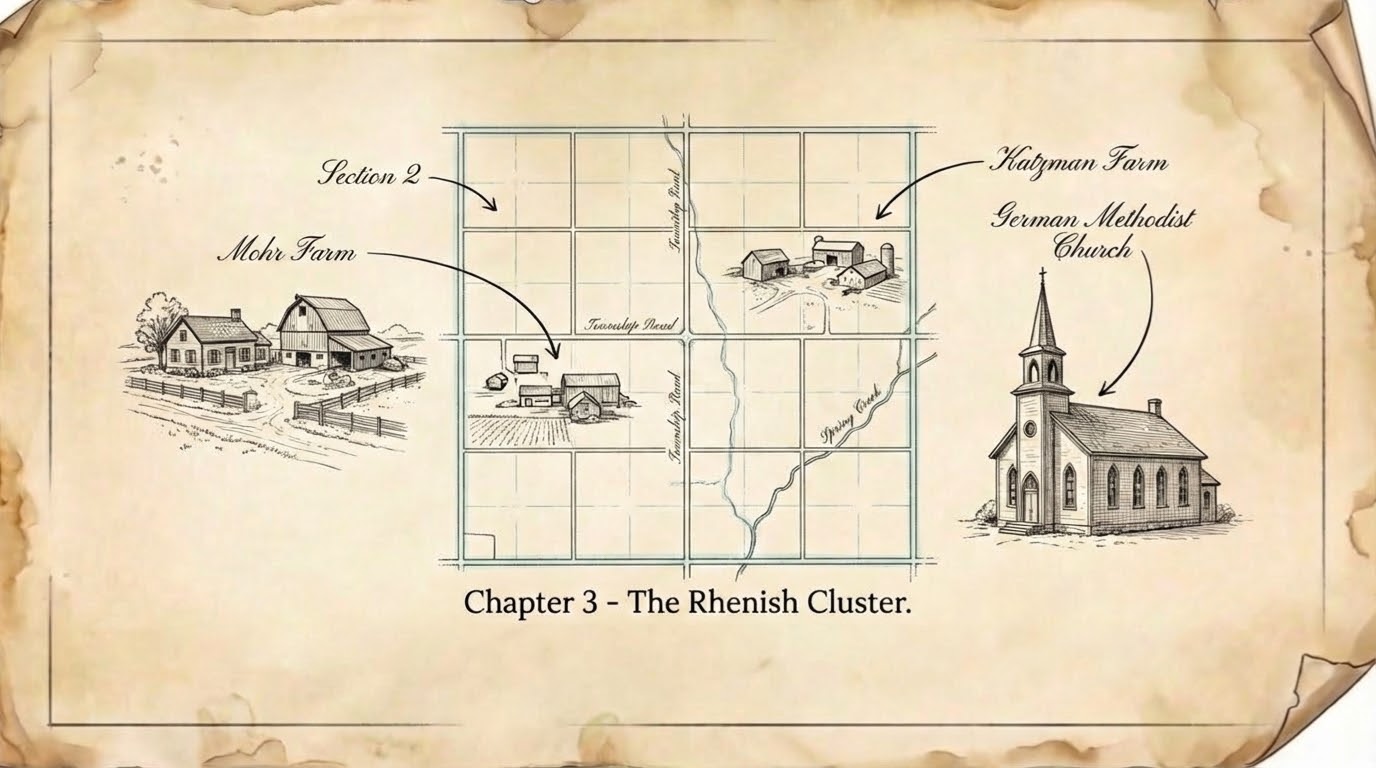
They reached the newly-minted state of Wisconsin just as its 1848 constitution was being signed—a document that granted voting rights to immigrants after only one year, specifically to attract European democrats. The Mohrs settled in Section 2 of Spring Prairie, Walworth County, in what became known as the German Settlement.
Technical Div.
A spatial reconstruction of Section 2, Spring Prairie, identifying the Mohr and Katzman farm boundaries adjacent to the German Methodist Church.
The Rhenish Cluster
This was a Rhenish Cluster of families from the same revolutionary districts. Here, they didn't build a traditional state church; instead, Johann Adam helped found the German Methodist Episcopal Church. It was a spiritual network that mirrored their political ideals: democratic, egalitarian, and fiercely community-focused. They were surrounded by neighbors who shared their journey, including the Katzman and Krahn families, whose lives would soon intertwine with the Mohr lineage through marriage.
The Legacy of the Forty-Eighters
The revolutionary fire of the Forty-Eighters did not die out on the Wisconsin prairie; it transformed. The German Methodists of Spring Prairie became vocal pillars of the early Republican Party and the Abolitionist cause. By the time Johann Adam's son, Henry Mohr, reached adulthood, the family was a cornerstone of the county.
Technical Div.
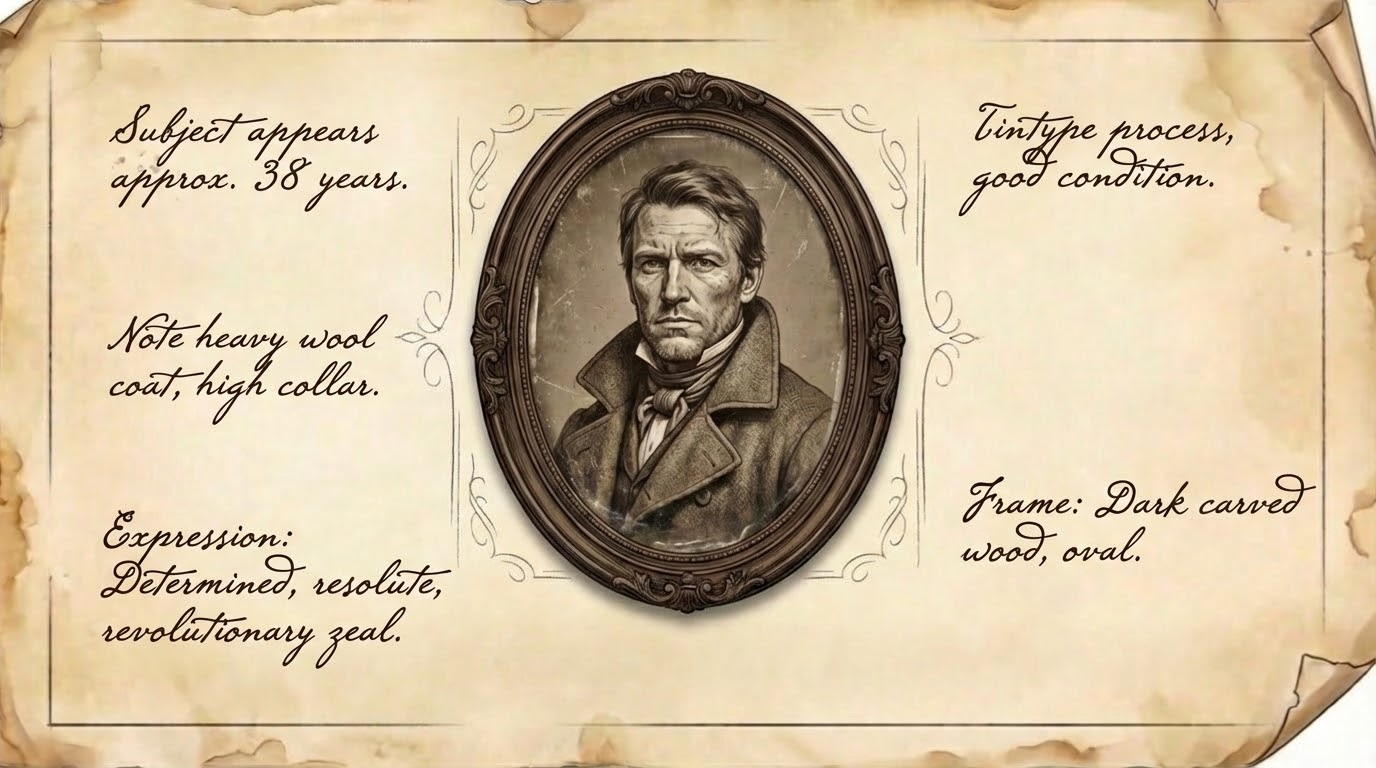
Johann Adam Mohr: A reconstructed portrait of the Geinsheim revolutionary in his prime.
The Vanguard
Henry was born in 1850—the first of his line to be born a free citizen of the Republic. While the history books remember him as a prominent farmer and a Republican member of the town board, his success was the direct harvest of the seeds of dissent planted by his father in the Rhine valley. The Mohr legacy remains a testament to the belief that a family's true strength is forged in the flight toward freedom.